


Quick Answer
Mughal art and architecture emerged between 1526 and 1857 and is a wonderful blend of Persian, Central Asian, and Indian traditions. This style, known for the symmetrically laid out buildings, domed tombs and elaborate jali work in Mughal architecture and bright miniature paintings, defined India’s cultural identity and continues to inspire design, history and architectural studies across the globe.
Quick Overview
| Thing | Why It Matters |
| Persian + Indian Blend | Created a unique visual language in architecture |
| Red Sandstone & White Marble | Signature materials that define Mughal grandeur |
| Symmetry & Charbagh Gardens | Reflect Mughal ideas of paradise and order |
| Miniature Paintings | Document court life, nature and royal stories |
| Jali & Pietra Dura Work | Showcase unmatched craftsmanship and detail |
Table of Contents
1. What is Mughal Art and Architecture?
2. Historical Background of the Mughal Empire
3. Evolution Under Different Emperors
4. Key Features of Mughal Architecture
5. Materials Used in Mughal Buildings
6. Mughal Painting and Miniature Art
7. Famous Mughal Monuments
8. Influence on Indian Design
9. Why Architecture Students Should Study This
10. Tips to Remember for Exams
11. Conclusion
12. FAQs
What is Mughal Art and Architecture?
The art and architecture of Mughal empire grew from a powerful cultural meeting point. When Babur founded the Mughal dynasty in 1526, he carried Persian aesthetics into the Indian subcontinent. Over generations, Mughal rulers fused those influences with Indian craftsmanship, Rajput traditions, and Islamic geometry to build one of history’s most recognisable visual styles.
This style covers two broad domains: built structures, forts, mosques, tombs, and palaces, and fine arts including mughal miniature paintings, calligraphy, carpet weaving, and jewelry. Together, they form the cultural fingerprint of an empire that ruled most of the Indian subcontinent for over 300 years.
Historical Background of the Mughal Empire
Babur defeated Ibrahim Lodi in the First Battle of Panipat in 1526 , and founded the Mughal Empire . Babur, who was descended from Timur on his father’s side and Genghis Khan on his mother’s, carried with him a rich history of Persian and Central Asian court culture. His memoirs, the Baburnama, show a love of art, gardens and beauty, and constitute the philosophical groundwork for all later Mughal creative production.
At its political zenith under Akbar, Jahangir, Shah Jahan and Aurangzeb, the empire covered much of present-day India, Pakistan, Bangladesh and Afghanistan. The sheer extent of this reach meant that Mughal art and culture absorbed local traditions from Bengal to Rajputana, giving rise to regional variants while retaining a consistent imperial style.
Evolution of Mughal Art and Architecture Under Different Emperors
Babur and Humayun Early Persian and Central Asian Influence
Babur introduced the charbagh garden in Mughal architecture, a four-quadrant garden layout drawn from Persian paradise traditions. Humayun extended these foundations but spent years in exile in Persia, deepening his exposure to Safavid art. His tomb, built posthumously during Akbar’s reign, became the first true landmark of mughal architecture in India.
Akbar – Red Sandstone, Forts, and Blended Indian Design
The period of Akbar (1556–1605) is considered to be the most transformative period of Mughal architecture. He built the architecture of Fatehpur Sikri from native red sandstone and a unique blend of styles. Rajput columns, Hindu brackets and Persian arches were fused to create a unique architectural language.
Akbar’s philosophy of religious tolerance was also reflected in his buildings, which drew upon a range of creative sources. During his reign Hindu craftsmen were active in Mughal art and architecture and Mughal patronage was extended to the Rajputs as well.
Jahangir – Refined Art, Nature-Inspired Paintings, and Marble Detail
Jahangir was known for his refined artistic taste and attention to natural detail. Under his rule, Jahangir architecture became more delicate, with the increased use of fine marble inlay work and elegant structural designs.
At this time Mughal painting features also reached their peak, especially in the field of miniature painting. Mansur and other artists made incredibly detailed and realistic studies of birds and flora, frequently with scientific accuracy. The subjects and portraits of nature become more frequent, which is a sign of mature Mughal artistic expression.
Shah Jahan – White Marble, Symmetry, and Imperial Perfection
Shah Jahan’s reign (1628–1658) gave the world its most iconic structures. Taj Mahal Mughal architecture stands as the pinnacle of this period; its white marble, perfect symmetry, and pietra dura in Mughal architecture represent an empire at the height of its aesthetic confidence. He also built the Red Fort Mughal architecture complex in Delhi and the Jama Masjid, the largest mosque in India.
Aurangzeb and Later Mughals – Simpler Structures and Regional Continuity
Aurangzeb’s austere religious views reduced imperial artistic patronage. Architecture became simpler and more functional. After his death in 1707, the empire fragmented, but Mughal aesthetic traditions continued at regional courts in Hyderabad, Lucknow, and Murshidabad ,keeping the visual vocabulary alive well into the 18th and 19th centuries.
“Mughal architecture does not merely copy Persian precedents, it absorbs them and reinvents them through the Indian climate, materials, and spiritual sensibility.”
Key Features of Mughal Architecture
The main features of Mughal architecture can be seen in the empire’s most important structures, so architecture and history students should know about them. These things are also covered in great detail on test questions and are often looked at in design studies and architectural theory.
| Feature | Description |
| Bulbous Domes | Double-layered domes inspired by Persian tradition |
| Charbagh Garden | Four-quadrant garden symbolising paradise (Quranic) |
| Jali Work | Intricate stone lattice screens for light and ventilation |
| Pietra Dura | Floral inlay of semi-precious stones in marble |
| Iwan & Arches | Grand arched gateways framing the main structure |
| Minarets | Tall towers flanking mosques and tombs for visual balance |
Action point: Sketch a typical Mughal elevation showing the dome, iwan, minarets, and jali screen, this visual memory exercise is highly effective for NATA and UPSC preparation.
Materials Used in Mughal Buildings
The materials selected varied significantly from the Mughal era to the Mughal style. In Mughal architecture, early buildings were often built using red sandstone and white marble as substitutes. Akbar almost entirely utilised red sandstone, whereas Shah Jahan used pure white marble. Later constructions typically mixed the two for contrast.
- Red sandstone: Found in abundance at Agra and Fatehpur Sikri, it is bold and warm in appearance
- White marble from Makrana in Rajasthan was utilised for Shah Jahan’s monuments
- Jali work in Mughal architecture: stone screens, carefully carved for privacy and filtered light.
- Lime mortar and brick: used in secondary structures and foundations
- Semi-precious stones: lapis lazuli, turquoise, and onyx for pietra dura floral inlays
Mughal Painting and Miniature Art: Themes, Style, and Court Patronage
If architecture defined Mughal space, Mughal paintings defined Mughal time. Court artists recorded wars, hunts, royal portraits, and pictures for romantic poetry with incredible detail. Under Humayun and Akbar, Persian artists such as Mir Sayyid Ali and Abd al-Samad mentored Indian artists, giving rise to a fast developing workshop culture.
Key mughal art architecture and painting themes include:
- Imperial portraiture with life-like facial expression and golden halos
- Nature studies, particularly flowers, birds, and animals under Jahangir
- Battle scenes and court ceremonies documenting historical events
- Illustrations of Persian literary classics like the Shahnama and Khamsa
Action point: Compare a Mughal miniature painting with a Rajput miniature, note the differences in background treatment, figure proportions, and spatial depth. This comparison frequently appears in art history examinations.
Famous Mughal Monuments Students Should Know
These well-known Mughal monuments are important for people who love heritage, are studying architecture, or are taking the UPSC test.
| Monument | Emperor | Key Feature |
| Taj Mahal, Agra | Shah Jahan | Pietra dura, white marble, charbagh |
| Humayun’s Tomb, Delhi | Akbar | First double dome in India |
| Fatehpur Sikri, UP | Akbar | Red sandstone, Rajput-Persian mix |
| Agra Fort | Akbar / Shah Jahan | Massive red sandstone walls + marble halls |
| Red Fort, Delhi | Shah Jahan | Lahori Gate, Diwan-i-Aam, Diwan-i-Khas |
Detailed Notes on Key Monuments
Taj Mahal – Shah Jahan’s Ode in Marble
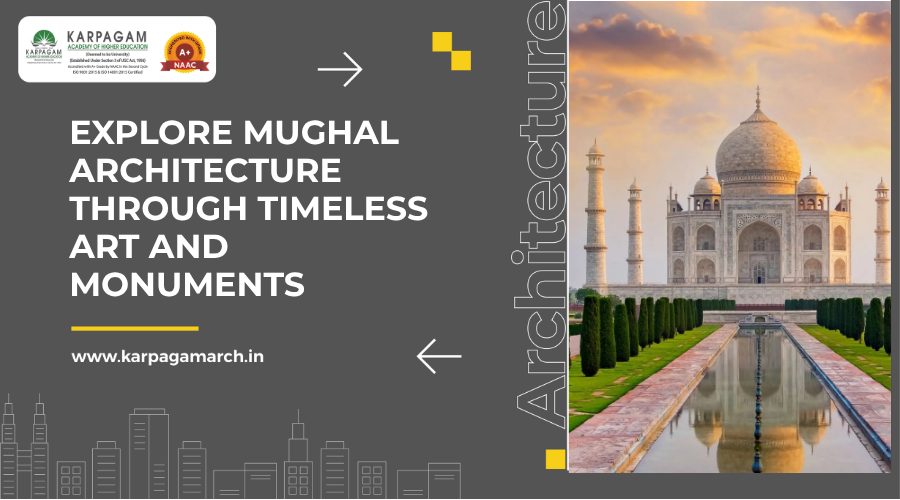
Taj Mahal Mughal architecture (1632–1653) in Agra is UNESCO-listed and globally recognised as a symbol of love and imperial perfection. Its double dome rises 73 metres; four minarets frame the tomb at slight outward angles to protect the main structure in case of collapse. The charbagh garden in Mughal architecture here is divided by water channels representing the four rivers of paradise.
Humayun’s Tomb – Blueprint for the Taj
Humayun’s Tomb, which was built between 1565 and 1572, is thought to be India’s first fully completed double-dome structure. The wife of Humayun, Haji Begum, paid for it, and the Persian builder Mirak Mirza Ghiyas made it. There were important features in the tomb, like the charbagh garden layout, a raised platform, and an octagonal plan, which later showed up in the Taj Mahal.
Fatehpur Sikri – Akbar’s City of Faith
Built entirely in red sandstone, Fatehpur Sikri architecture near Agra (1571–1585) was Akbar’s short-lived imperial capital. Its Buland Darwaza a 54-metre-tall victory gate, is among the tallest gateways in the world. The complex blends Hindu columns, Jain motifs, and Islamic geometry in a single coherent ensemble.
“Every brick of Fatehpur Sikri carries Akbar’s vision of an India where no single faith owned the sky.”
Influence of Mughal Art and Architecture on Indian Design
Mughal architecture features such as the double dome, garden tomb, and jali screen continue to appear in contemporary Indian design. Colonial-era architects adopted Mughal motifs for civic buildings; modern architects reference them for cultural resonance. Textile patterns rooted in mughal art particularly floral inlay and arabesque geometry remain alive in block printing, embroidery, and jewellery design across Rajasthan and Uttar Pradesh.
Why Architecture and History Students Should Study Mughal Art
Studying this tradition builds critical skills that go beyond memorising monuments. It teaches how climate shapes material choice (sandstone vs marble), how political ideology translates into spatial planning (symmetry as power), and how cross-cultural dialogue produces innovation. If you are exploring a career in architecture, institutions offering structured design history programmes, such as the Best B.Arch Colleges in Tamilnadu, integrate Mughal architectural analysis into their syllabus as part of Indian architectural heritage modules.
Tips to Remember Mughal Art and Architecture for Exams
- Use the acronym BAHJS (Babur → Akbar → Humayun → Jahangir → Shah Jahan) in chronological order
- Associate each emperor with one signature material: Akbar = red sandstone, Shah Jahan = white marble
- Remember the three ‘D’s of Mughal painting: Detail, Delicacy, and Documentation
- For monuments: learn the city, emperor, year, and one unique structural feature for each
- Draw a simple Mughal elevation from memory, dome + iwan + minarets + jali, this technique aids spatial recall
Conclusion
Mughal art and architecture remains one of humanity’s most sophisticated artistic legacies. From Babur’s earliest charbagh gardens to Shah Jahan’s marble masterpieces, every generation of Mughal rulers added a distinct layer to an evolving visual tradition. Understanding its history, materials, painting styles, and famous monuments gives students whether studying architecture, history, or preparing for competitive exams, a deeper appreciation of how culture, politics, and craftsmanship intertwine to produce enduring beauty. Explore, sketch, and revisit these monuments whenever possible: no textbook substitutes for the lived experience of standing before a Mughal arch.
Frequently Asked Questions (FAQs)
1. What is Mughal art and architecture?
Mughal art and architecture include the artistic and building styles that developed during the Mughal Empire from 1526 to 1857. This style combines Persian, Central Asian, and Indian influences, which can be seen in grand monuments, miniature paintings, calligraphy, gardens, and decorative crafts.
2. What are the main features of Mughal architecture?
Mughal architecture is defined by several distinctive features, including bulbous double domes, the use of red sandstone and white marble, charbagh-style gardens, intricately carved jali lattice screens, pietra dura inlay work, grand iwans (arched entrances), and tall minarets. Together, these elements create a unique and easily recognisable architectural style that represents the Mughal period.
3. Which are famous examples of Mughal architecture?
Some of the most famous Mughal monuments are the Taj Mahal in Agra, Humayun’s Tomb in Delhi, Fatehpur Sikri, Agra Fort, and the Red Fort. Each of these monuments showcases a different phase in the development of Mughal architecture. They display the bold use of red sandstone in earlier structures. In contrast, later masterpieces feature elegance, symmetry, and extensive white marble.
4. Who introduced Mughal architecture in India?
While Babur introduced the early ideas that influenced Mughal design, Akbar gave the style a distinctive identity by merging Indian, Persian, and Central Asian architectural traditions. During Akbar’s reign, Humayun’s Tomb was widely regarded as one of the best examples of mature Mughal architecture in India, exhibiting its planning, symmetry, and garden layout.
5. What is the difference between Mughal art and Mughal architecture?
A Mughal structure, such as a fort, mosque, or tomb, falls into the category of architecture. In addition to paintings and calligraphy, textiles and crafts are all part of Mughal art. While both share similar influences, architecture is structural, while art is visual; they are the two aspects which define Mughal aesthetics.
6. Why is the Taj Mahal called an example of Mughal architecture?
The Taj Mahal is considered the finest example of Mughal architecture because it brings together all the key elements of the style in a single monument. Built by Shah Jahan, it features stunning white marble, a double dome, a beautifully planned charbagh garden, intricate pietra dura inlay work, and remarkable symmetry. Its harmony of design, craftsmanship, and proportion makes it one of the most celebrated achievements of the Mughal architectural tradition.
7. What materials were used in Mughal architecture?
Styles and materials used in Mughal architecture have evolved over time. During the early Mughal period, red sandstone was used to construct buildings, such as Fatehpur Sikri. In later monuments, white marble was extensively used, reflecting elegance and refinement. In addition to lime plaster and intricately carved jali (lattice) stone screens, semiprecious stones were used for inlay work, and glazed tiles added colour and detail.
8. What is pietra dura in Mughal architecture?
Pietra dura is an Italian term for the art of inlaying colourful semi-precious stones into marble to create intricate floral or geometric designs. Introduced during Shah Jahan’s reign, it is most prominently seen on the Taj Mahal’s exterior walls and cenotaphs.