


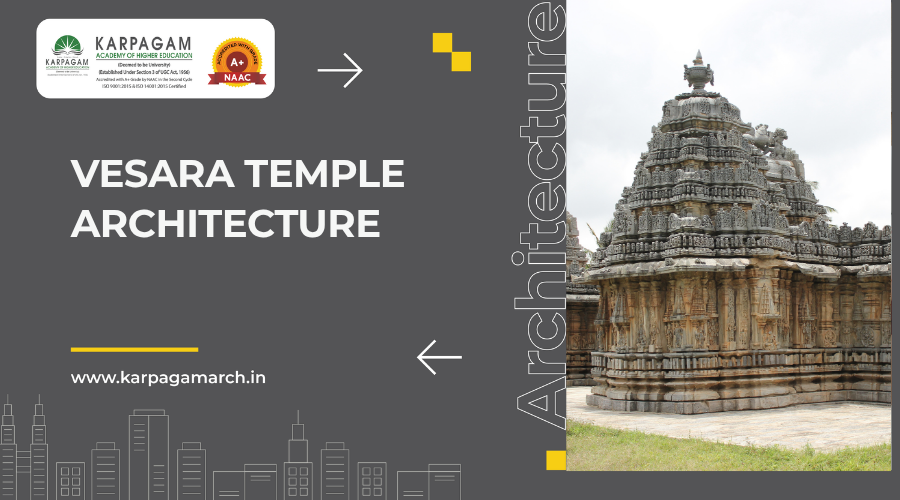
Quick Answer
Vesara architecture is a hybrid Indian temple style that blends Nagara curves with Dravidian tiers, developed in Karnataka’s Deccan region by the Chalukyas, Rashtrakutas, and Hoysalas. It is well known for its star-shaped designs, shorter pyramidal towers, and elaborate carvings, which can be found in Aihole, Pattadakal, Ellora, Belur, Halebidu, and Somnathpura, making it crucial study material for architecture students.
Quick Overview Table
| Aspect | Gist |
| Style | Hybrid of Nagara and Dravidian architecture |
| Region | Deccan region, mainly Karnataka |
| Key dynasties | Chalukyas, Rashtrakutas, Hoysalas |
| Signature feature | Star-shaped (stellate) temple plan |
| Tower type | Shorter, pyramidal, richly carved |
| Famous examples | Belur, Halebidu, Somnathpura, Ellora |
Table of Contents
- Introduction
- What is Vesara Architecture?
- Origin and Development of Vesara Style
- Why Vesara is Called a Blend of Nagara and Dravidian Styles
- Main Features of Vesara Style Temples
- Temple Plan and Layout
- Materials and Craftsmanship
- Nagara vs Dravidian vs Vesara
- Dynasties Linked with Vesara Architecture
- Famous Vesara Style Temple Examples
- Chalukyan Examples
- Rashtrakuta and Ellora Example
- Hoysala Examples
- Why Vesara Architecture Matters for Students
- Common Misconceptions
- FAQs
- Conclusion
Introduction
Walking around northern Karnataka, you’ll see temples that don’t look either North or South Indian. Their towers curve like Nagara shikhara in some areas while stacking in tiers like Dravidian vimanas in others. That combination is deliberate. This blog explains Vesara Architecture, a hybrid temple style that originated in the Deccan region and continues to captivate architecture students studying India’s built heritage today.
Important accuracy note
Historical dates and dynasty timelines vary slightly across sources. This blog covers frequently accepted academic ranges and is intended for general learning rather than exam-verbatim reference.
What is Vesara Architecture?
Vesara architecture is a hybrid Indian temple design that combines the curved shikhara of the northern Nagara tradition and the tiered, pyramidal vimana of the southern Dravidian heritage. The phrase is thought to come from a Sanskrit word, and the style is intimately associated with temple construction in the old Deccan Plateau region, particularly in modern-day Karnataka.
Origin and Development of Vesara Style
The Chalukyas of Badami developed the style between the 6th and 8th centuries CE, in the region between the Krishna and Tungabhadra rivers. It was later carried forward by the Rashtrakutas and achieved its most refined, ornamental form during the Hoysala dynasty, which reigned from the 11th to 13th centuries CE.
Why Vesara is Called a Blend of Nagara and Dravidian Styles
Vesara earned the “hybrid” name because early Deccan builders did not precisely adhere to northern or southern standards. They freely mixed stepped Dravidian vimana forms with Nagara-style wall articulation and stellate ground designs, resulting in a distinct regional character rather than a mere blending of two existing traditions.
- Curvilinear tower elements inspired by Nagara design
- Dravidian vimana structure with tiers and pyramids
- Ground plans shaped like stars or stepped diamonds
- Evolving decorative character throughout generations
Main Features of Vesara Style Temples
Vesara temples are distinguished by their star-shaped or stellate platforms, shorter towers than Nagara shikharas, and extensive surface embellishment. Sculptors preferred small ornamental towers, elaborate pillar carving, and narrative panels depicting epic and Puranic scenes on temple walls and mandapas.
| Feature | Description |
| Ground plan | Star-shaped or stepped-diamond outline |
| Tower height | Shorter and more compressed than Nagara |
| Ornamentation | Dense carving on walls, pillars, ceilings |
| Vimana | Tiered, pyramidal, richly decorated |
| Mandapa | Pillared hall, often larger than sanctum |
Temple Plan and Layout
A typical Vesara temple layout consists of a garbhagriha (sanctum), an antarala (vestibule) that connects it to the mandapa, and a surrounding jagati or raised platform. Some Vesara temples have a panchayatana layout, with a main shrine surrounded by smaller subsidiary shrines at each corner.
Materials and Craftsmanship
Early Chalukyan architects worked mostly with sandstone, but Hoysala artisans eventually used soft soapstone, which allowed for exceptionally delicate, lathe-like carving. This material change directly influenced the elaborate, almost jewel-like decoration found on subsequent Vesara temple surfaces, pillars, and ceiling medallions.
Nagara vs Dravidian vs Vesara
Comparing the three primary Indian temple traditions reveals what distinguishes Vesara. Nagara prefers large curvilinear towers, Dravidian prefers pyramidal storeyed vimanas with gopurams, and Vesara falls somewhere in between, drawing on elements from both styles.
| Aspect | Nagara | Dravidian | Vesara |
| Region | North India | South India | Deccan, mainly Karnataka |
| Tower shape | Tall, curvilinear shikhara | Pyramidal, storeyed vimana | Shorter, pyramidal, mixed |
| Enclosure | Usually no boundary wall | Walled compound, gopurams | Often no compound wall |
| Ground plan | Square, stellate variations | Square with storeys | Star-shaped, stepped-diamond |
Dynasties Linked with Vesara Architecture
Several reigning dynasties over the centuries shaped Vesara architecture. The Chalukyas of Badami established the style; the Rashtrakutas enlarged it at sites such as Ellora; the Chalukyas of Kalyani honed its regional identity; and the Hoysalas culminated in its most complex form in southern Karnataka.
- Early experimentation among the Chalukyas at Badami (6th-8th century CE)
- The Rashtrakutas of Manyakheta expanded significantly, particularly in Ellora
- The Chalukyas of Kalyani exhibit remarkable regional refinement
- Hoysalas (11th-13th century CE): most elaborate and mature examples
Famous Vesara Style Temple Examples
Several temples in Karnataka and Maharashtra remain the most visible teaching examples of Vesara architecture for students today. Each represents a different stage of the style’s evolution, from early Chalukyan experimentation to the highly ornate Hoysala period, making them useful case studies for architectural history classes and site visits.
Chalukyan Examples
The Ladkhan Temple at Aihole and the temples of Pattadakal, particularly the Virupaksha Temple, are examples of early Chalukyan experimentation with Vesara concepts. Aihole is commonly referred to as an early temple design laboratory, where architects experimented with Nagara and Dravidian features alongside one another before the style matured further.
Rashtrakuta and Ellora Example
The rock-cut Kailasa Temple at Ellora, commissioned under Rashtrakuta patronage, is one of the most famous Vesara-influenced monuments. Carved from a single rock face, it reveals how Deccan builders used various stylistic aspects even within a monolithic, excavated building rather than built masonry structures.
Hoysala Examples
The Chennakeshava Temple at Belur, the Hoysaleswara Temple at Halebidu, and the Keshava Temple at Somnathpura are examples of complex Vesara architecture. These temples, constructed primarily of soapstone, have star-shaped designs, stacked towers, and exceptionally elaborate sculptural work on practically every surface.
Belur, Halebidu, and Somanathapura are recognised by UNESCO as the Sacred Ensembles of the Hoysalas.
Why Vesara Architecture Matters for Students
For architecture and heritage students, Vesara provides a practical example of style synthesis, demonstrating how regional builders altered inherited traditions rather than duplicating them entirely. Studying it also improves knowledge of Nagara and Dravidian foundations, as Vesara makes sense only when compared to both parent forms.
When looking for the best architecture college in Coimbatore, consider curriculum strength and site-study exposure, as well as other universities that offer specific Indian architecture history modules.
Common Misconceptions
Vesara is commonly misunderstood as a purely decorative variety of Dravidian architecture, but it is essentially a distinct structural synthesis with its own planning logic. It is also inaccurately considered a single set style, despite developing significantly during the Chalukya, Rashtrakuta, and Hoysala periods.
- Vesara is more than just “Dravidian with extra carving”
- It did not remain consistent over dynasties
- Star-shaped plans serve both structural and decorative purposes
- Not all Deccan temples are automatically classified as Vesara
FAQs
What is Vesara architecture?
Vesara architecture is a hybrid Indian temple style that combines Nagara curvilinear towers with Dravidian tiered vimanas, originating in Karnataka’s Deccan area.
What are the main features of Vesara style temples?
Star-shaped designs, shorter pyramidal towers, rich wall and pillar carvings, and huge pillared mandapas distinguish Vesara-style temples.
Why is Vesara architecture called a hybrid style?
It incorporates structural and ornamental aspects from both Nagara and Dravidian traditions, developing its own particular regional identity throughout time.
Who introduced Vesara style of architecture?
The Chalukyas of Badami are widely credited with establishing Vesara architecture, which was developed by the Rashtrakutas and matured by the Hoysalas.
Which region is Vesara architecture mainly associated with?
Vesara architecture is most commonly linked with the Deccan region, specifically present-day Karnataka, between the Krishna and Tungabhadra rivers.
How is Vesara different from Nagara and Dravidian styles?
Vesara temples are shorter than Nagara towers and less rigorously storeyed than Dravidian vimanas, featuring star-shaped plans and mixed decoration.
What are famous examples of Vesara style temples?
Temples in Aihole and Pattadakal are well-known examples, as are the Kailasa Temple in Ellora and the Hoysala temples at Belur, Halebidu, and Somnathpura.
Which dynasties developed Vesara temple architecture?
The Chalukyas of Badami, the Rashtrakutas of Manyakheta, the Chalukyas of Kalyani, and the Hoysala dynasty all helped shape Vesara architecture.
Conclusion
Vesara Architecture is still one of India’s most instructive examples of style synthesis, demonstrating how Deccan builders transformed Nagara and Dravidian principles into something of their own. For students, examining temples in Aihole, Pattadakal, Ellora, Belur, Halebidu, and Somnathpura provides a grounded, example-based understanding of this growing hybrid heritage.