


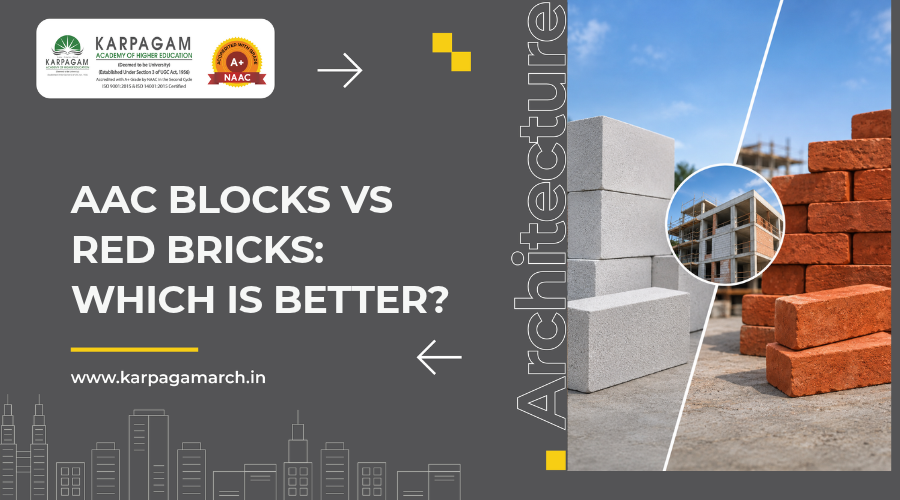
Quick Answer
The choice between AAC blocks and red bricks depends on the project. AAC blocks are lighter, larger, and factory-made, making them ideal for framed buildings where dead load and speed matter. Red bricks are widely available, well known to masons, and have proven effective in traditional brickwork. Neither is universally superior; consider engineering requirements, budget, climate, and local availability.
Quick Comparison Table
| Factor | AAC block | Red brick |
| Composition | Cement, lime, sand or fly ash, aerating agent | Fired clay |
| Weight | Lighter | Heavier |
| Size and uniformity | Large, factory-made, uniform | Smaller, varies by source |
| Compressive strength | Depends on grade | Depends on class |
| Thermal insulation | Generally better | Generally lower |
| Sound insulation | Depends on wall design | Depends on wall design |
| Fire resistance | Non-combustible | Non-combustible |
| Water absorption | Needs protection | Needs protection |
| Mortar and plaster | Often less | Often more |
| Construction speed | Usually faster | Usually slower |
| Initial material cost | Varies by region | Varies by region |
| Overall project cost | Depends on the whole wall system | Depends on the whole wall system |
| Sustainability | Depends on production and transport | Depends on kiln practice and soil use |
| Common uses | Infill walls, partitions | Conventional masonry, matching work |
Table of Contents
- Introduction
- What Are AAC Blocks?
- What Are Red Bricks?
- Key Differences Between AAC Blocks and Red Bricks
- Advantages of AAC Blocks
- Disadvantages of AAC Blocks
- Advantages of Red Bricks
- Limitations of Red Bricks
- Where Are AAC Blocks Commonly Used?
- Where Are Red Bricks Commonly Used?
- Which Is Better for Construction: AAC Blocks or Red Bricks?
- Conclusion
- FAQs
Introduction
Wall options influence a building’s weight, cost, comfort, and schedule. Students, homeowners, and builders often compare AAC bricks with traditional clay units before deciding. This article explains both materials in simple terms to help you make an informed decision based on your project needs.
What Are AAC Blocks?
AAC stands for Autoclaved Aerated Concrete, a lightweight material with an air-filled cellular structure. Factories manufacture it using cement, lime, sand or fly ash, and an aerating agent, then steam-cure it in an autoclave. BIS defines it based on oven-dry density.
What Are Red Bricks?
Red bricks are traditional burnt clay bricks used in Indian construction for generations. They remain popular because of their familiar sizes, local supply, and well-known artistry, although quality depends on the clay, firing, and the mason’s expertise.
Key Differences Between AAC Blocks and Red Bricks
In addition to the table above, here’s how each AAC block vs red brick factor works in practice.
Weight and Structural Load
AAC blocks weigh much less than clay brick because the material is cellular. Lighter infill reduces dead load in framed buildings, but any savings in steel or foundations must come from project-specific engineering calculations, not fixed percentages.
Strength and Durability
In an AAC block vs red brick strength comparison, no single N/mm² value applies, because grades, standards and manufacturers vary. Both are suitable for infill when properly specified. Design, grade, code requirements, and structural engineering determine whether components are load-bearing.
Thermal and Sound Insulation
AAC’s air-filled cells can increase thermal performance and reduce cooling requirements. Acoustic behaviour depends on wall thickness, density, plaster, and joints; therefore, neither material should be considered superior without testing.
Fire Resistance
Both materials are generally not combustible. Fire-rating hours depend on block thickness, wall system, and approved test data; rely on documented results rather than broad assertions.
Water Absorption and Moisture Behaviour
Neither material is watertight. Both require external plaster or paint, competent artistry, and adequate damp-proofing, particularly at plinth level and exposed faces. Because of its permeable structure, AAC requires particularly appropriate finishes.
Size, Uniformity and Mortar Usage
Larger, factory-made AAC units often have fewer joints and less mortar. Compared with AAC blocks, red bricks are smaller, and their dimensions and finish may vary by source, potentially increasing mortar and plaster use.
Construction Speed and Labour
AAC block building is usually faster because it requires fewer, larger units to cover a wall and may be sliced and thin-jointed with appropriate adhesive. Red brick masons are more readily available; therefore, labour familiarity is important. Trained installers help AAC perform well.
AAC Blocks vs Red Bricks Cost
The unit price is only part of the tale. For a realistic price comparison between AAC blocks and red bricks, factor in mortar or adhesive, plaster, labour, transportation, structural dead weight, and build time. Rates differ by region; therefore, no uniform advantage exists.
Environmental Impact
Clay bricks raise kiln-firing and topsoil difficulties, whereas AAC requires manufacturing energy and transportation weight. Waste and life-cycle impacts also matter. Neither material is automatically green without supporting data.
Also Read: https://karpagamarch.in/innovative-and-eco-friendly-materials-for-sustainable-architecture/
Advantages of AAC Blocks
When properly specified, AAC blocks for construction have the following benefits:
- Lightweight walling decreases dead loads
- Uniform size and finish
- Faster walling using fewer units
- Better thermal insulation
- Potentially less mortar and plaster
- Suitable for modern frame construction
Disadvantages of AAC Blocks
Knowing the downsides of AAC blocks will help you avoid site troubles.
- Skilled installation is required
- Special fasteners or anchors are needed
- Blocks may be damaged upon handling
- Moisture protection is crucial
- Availability varies by area
- Compatible adhesive and plaster systems are required
Advantages of Red Bricks
Red bricks are still a solid choice in many situations:
- Wide availability and local sourcing in many regions
- Familiar artistry and proven conventional use
- Suitable where traditional brickwork is preferred
Limitations of Red Bricks
A fair red brick vs AAC block comparison also highlights the following limitations of clay bricks:
- Higher dead load
- More joints may require more cement and plaster
- Slower walling
- Dimensional variation
- Environmental problems associated with burned clay production
Where Are AAC Blocks Commonly Used?
AAC block walls are commonly used as infill in RCC and steel-framed buildings, particularly where:
- Apartments and commercial structures require lower dead loads
- Partitions are required
- The project prioritises speed
Confirm wall design, fittings, and finishes with the structural and architectural teams.
Where Are Red Bricks Commonly Used?
When deciding between AAC bricks vs red bricks, red bricks remain appropriate for traditional residential masonry, locally available building, renovation or matching work, and projects built exclusively for brick masonry. They are also practical when masons and supply systems are already established.
Which Is Better for Construction: AAC Blocks or Red Bricks?
When choosing the best brick for construction, no single material wins in every situation. Consider these factors with your engineer:
- Structure and project height
- Climate and thermal goals
- Wall functionality and engineering requirements
- Local availability and skilled labour
- Budget and Build Speed
There is no fixed score sheet; instead, prioritise these aspects for your site and then compare quotations and technical data sheets for the specific products you are evaluating.
Make the brick vs AAC block decision based on quotations that cover the whole wall system.
Students who want to study material selection in depth might look at programs at the Best Architecture Colleges in Coimbatore.
Also Read: https://karpagamarch.in/innovations-in-construction-techniques-and-materials/
Conclusion
AAC blocks vs red bricks has no single winner. Choose based on structure, climate, budget, speed, and local availability, and confirm grade, standard, and pricing with your engineer and supplier before installing your wall system.
FAQs
1. Are AAC blocks stronger than red bricks?
Not necessarily. Each material’s strength depends on its grade, standard, and manufacturer, so no single rating applies. When properly specified, both work well for infill walls. For load-bearing use, follow structural design and code standards; consult a structural engineer before deciding.
2. Which is cheaper overall?
It depends on the project and the region. AAC units may cost more or less per piece, but the overall cost includes mortar or glue, plaster, labour, transportation, structural load, and building time. Instead of focusing only on unit pricing, compare full wall-system quotes from nearby suppliers.
3. Which is better for house construction?
Both can work nicely. AAC blocks suit framed homes that need lighter walls, uniformity, and speed, while red bricks suit traditional masonry with locally available expert masons. Your structural design, climate, budget, and engineer’s advice should all influence your final decision.
4. Are AAC blocks suitable for load-bearing walls?
Sometimes, but only when the design, block grade, code standards, and structural engineering permit it. Most projects use AAC as a non-load-bearing filler in framed buildings. Never infer load-bearing suitability from marketing materials; instead, consult a trained structural engineer and the relevant standards.
5. Do AAC blocks crack easily?
Not intrinsically. Cracks often result from improper handling, weak joints, missing movement joints, dampness, inappropriate plaster, or building movement. Proper storage, appropriate glue and plaster, expert installation, and fine detailing help limit the risk. Red brick walls can also crack due to poor design or craftsmanship.
6. Which material has better thermal insulation?
AAC has greater thermal performance because its air-filled cellular structure slows heat movement. The exact result depends on wall thickness, plaster, orientation, and overall building design; use any comparison as a guideline, and confirm tested statistics for your preferred product.
7. Which is lighter?
AAC blocks are lighter because of their cellular structure; therefore, AAC walling often adds less dead load than red brick walling. The exact difference depends on the density class and wall thickness, so engineers use project-specific data to calculate loads.
8. Which lasts longer?
Both can last for decades if properly built, specified, and maintained. The longevity of AAC blocks versus red bricks depends on material quality, moisture protection, plaster, artistry, and exposure; therefore, neither is uniformly longer-lasting without project and product data.
9. Do AAC blocks need plaster?
Usually, yes, for protection and a finished surface. AAC requires an appropriate plaster or coating system to regulate moisture, particularly on exterior faces. Follow the manufacturer’s instructions and confirm the finish suits your wall conditions, exposure, and local environment. Skipping finishing exposes the blocks to the elements and wear.
10. Which is better for the Indian climate?
It depends on the location. AAC’s thermal behaviour may help in hot climates, but heavy rain and humid places still need robust moisture protection for both materials. Choose based on local climate, exposure, wall detailing, and engineering advice, rather than a blanket statement.