


Introduction
India’s skyline has changed radically in the last ten years as cities have adopted contemporary architecture and engineering masterpieces. From super-luxury residential skyscrapers to symbolic commercial icons, they all represent progress and aspiration.
For architecture students and enthusiasts, understanding these skyscrapers is not just fascinating but also educational, as each one represents advanced design concepts and structural brilliance.
Whether you are curious about which is the tallest building in India or looking to explore the finest examples of urban infrastructure, this guide will take you through the top ten towering structures reshaping the nation’s cityscapes.
The Rise of Skyscrapers In India
The growth of urbanization and the demand for premium living spaces have paved the way for some of the biggest skyscrapers in India. Cities like Mumbai, Bengaluru, and Kolkata are now home to world-class towers rivaling global standards.
For architecture students, such buildings present actual applications of structural innovation alongside aesthetic appeal. They also showcase challenges like the restriction of land availability, environmental issues, and the use of sustainable construction methods.
1. Palais Royale, Mumbai
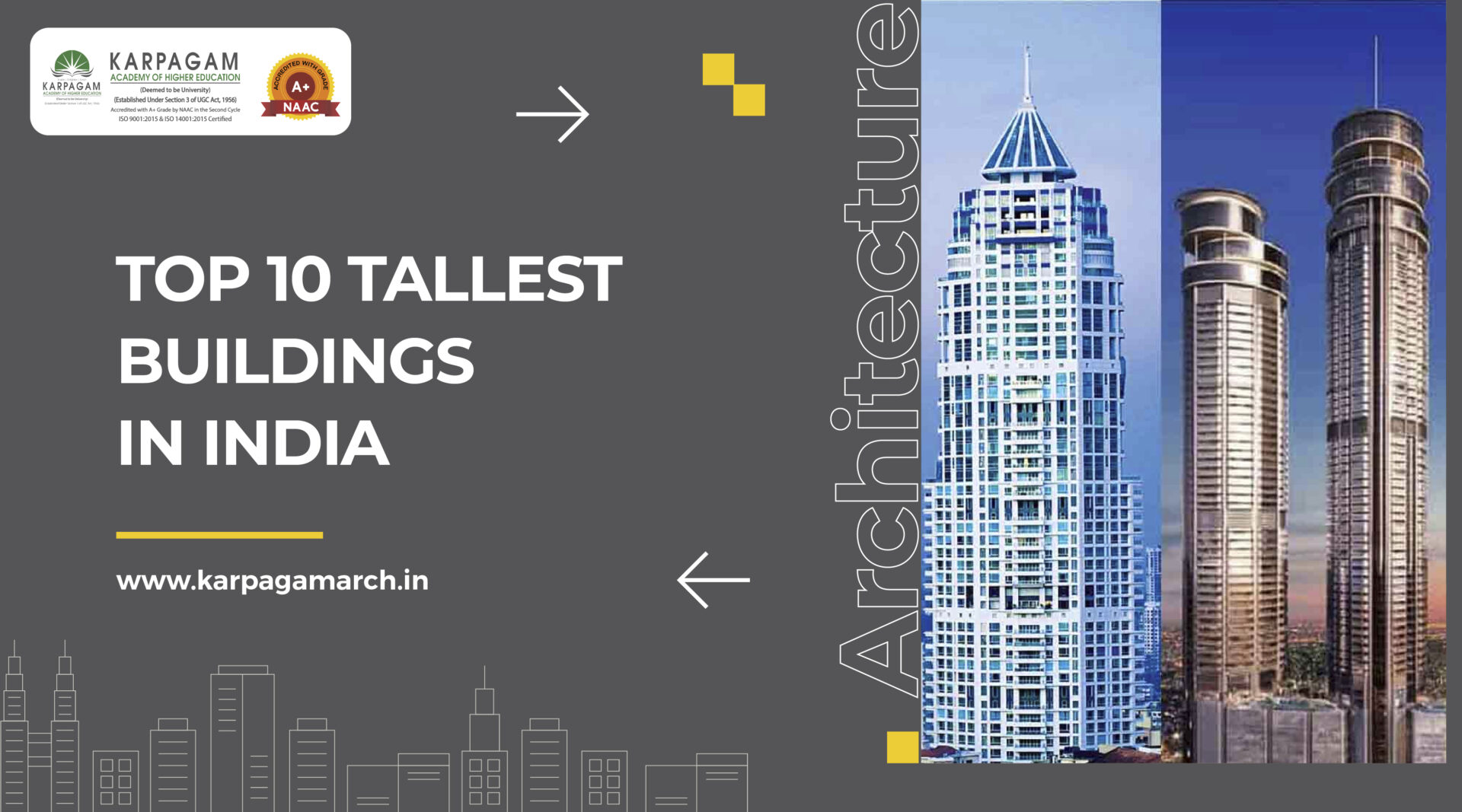
Standing high at about 320 meters, Palais Royale is India’s tallest residential tower. Situated in Lower Parel, Mumbai, it is 88 floors tall and features environmentally friendly architectural designs such as energy-efficient systems and recycling of water.
What makes Palais Royale unique is its focus on green building practices and the use of eco-friendly materials for sustainable architecture, making it a model for future skyscrapers in high-density cities.
2. World One, Mumbai
World One is another iconic structure, soaring up to 280 meters with 76 floors. It was created by the well-known architectural firm Pei Cobb Freed & Partners and combines contemporary style with useful living areas.
This India’s tallest residential tower was built using earthquake-resistant technology and provides bird’s eye views of the Arabian Sea. It is an ideal case study for students studying high-rise construction methods, especially when paired with detailed 3d house rendering visuals to better understand its complex design.
3. Lokhandwala Minerva, Mumbai
Lokhandwala Minerva, which is close to completion, measures approximately 300 meters. The tower personifies ultra-contemporary luxury and state-of-the-art engineering.
With a stainless glass façade and state-of-the-art amenities, it is likely to redefine the skyline of Mumbai. It’s also an excellent case study for students who want to know which is India’s tallest tower and how international architectural trends, including parametric architecture, shape local designs.
4. Imperial Towers, Mumbai
The Imperial Towers standing at 256 meters were once the tallest building in Mumbai until newer buildings cropped up.
The two towering buildings make up this complex and exemplify how great design integrates greatness and functionality. It remains a classic representation of India’s early 21st-century luxury residential developments.
5. Omkar 1973, Mumbai
Omkar 1973 comprises three connected towers, the highest of which stands at 267 meters. This development centers on delivering international-quality homes while optimizing space usage.
Its three-tower configuration provides a great case study for architecture students to study the largest tower in India ideas and multi-structure planning for one project site.
6. Three Sixty West, Mumbai
Three Sixty West is a striking twin-tower development, with its tallest tower standing at 255 meters. Known for its luxurious apartments and a five-star hotel, it integrates hospitality and residential design seamlessly.
This tower’s use of contemporary materials and design aesthetics makes it a prime example of mixed-use development in high-rise buildings.
7. Supernova Spira, Noida
Supernova Spira, reaching 300 meters, is North India’s contribution to the list of tallest buildings in India.
Located in Noida, this mixed-use development combines commercial spaces, residences, and retail areas, showing how skyscrapers can transform suburban regions into urban hubs.
8. The 42, Kolkata
Kolkata’s 42 is 260 meters tall and the tallest building in eastern India.
This project demonstrates how skyscraper building in a modern style is finding extensions beyond Mumbai and Delhi. Its design incorporates international style and local cultural contributions, being a strong study for students.
9. Lodha Trump Tower, Mumbai
Lodha Trump Tower is a skyscraping icon of contemporary luxury, measuring 268 meters in height. Its brand identity of ultra-superlative residences, the tower features international architectural influences in its design.
The project is also mindful of branding and lifestyle integration, providing significant lessons to researchers undertaking research on marketing in architecture.
10. Crescent Bay, Mumbai
Crescent Bay, a six-tower complex whose highest building stands at approximately 240 meters, is a community-oriented concept for high-rise living.
Its master-planned concept, open spaces, and advanced safety infrastructure illustrate how urban planning principles are practiced in skyscraper projects.
Why Mumbai Dominates India’s Skyline
Most of the top 10 tallest buildings in India are located in Mumbai due to its role as a financial and cultural hub. Limited land availability and high population density drive vertical development, making skyscrapers a necessity rather than a luxury.
Mumbai’s construction boom also provides ample learning opportunities for architecture students aiming to work on large-scale urban projects. Understanding these developments is enhanced by using software tools every architect should master for planning, visualization, and execution.
The Future of High-Rise Architecture in India
With growing technology, the future towers will be smart living focused, energy efficient, and sustainable. Concepts like vertical gardens, green roofs, and integration of solar and wind energy are becoming popular. Today, AI helps architects design smarter by optimizing layouts, improving energy efficiency, and predicting structural performance in advance.
All this says a lot about how emerging architects must learn from India’s tallest towers to know what direction urban development will take in the future.
Final Thoughts
India’s tallest buildings are not just stunning structures; they are monuments to innovation, grit, and the future of urban living. For aspiring students of architecture, studying these skyscrapers—including the highest building in India—provides valuable insights into structural shape, project management, and environmental practices, highlighting the impact of architecture on modern cityscapes.
If you have a passion to forge the future skyline, why not see what educational pathways are available through Top Architecture Colleges in Tamilnadu, where you can acquire the skills required to design tomorrow’s icons.
FAQ
1. Which is the tallest building in India right now?
Palais Royale in Mumbai currently holds the record with a height of approximately 320 meters.
2. What is the highest residential building in India?
Palais Royale also ranks as the highest residential tower in the country.
3. Where is the highest floor building in India located?
The highest floor building is located in Mumbai, which remains the center of India’s skyscraper development.
4. What are the top 10 tallest buildings in India by height?
The list includes Palais Royale, World One, Lokhandwala Minerva, Imperial Towers, Omkar 1973, Three Sixty West, Supernova Spira, The 42, Lodha Trump Tower, and Crescent Bay.
5. Is Mumbai home to the biggest skyscraper in India?
Yes, Mumbai hosts most of the tallest towers, including Palais Royale and World One.
6. What makes the architecture of India’s tallest towers unique?
They combine modern engineering with sustainable practices, while also reflecting global trends and local cultural elements.
About Karpagam Architecture
Karpagam Architecture is one of the premier architecture colleges in Coimbatore, offering a dynamic learning environment. Our institution is dedicated to providing top-quality education, fostering creativity, and developing innovative architects for the future.
With a focus on hands-on experience and industry-relevant knowledge, we empower students to excel in the field of architecture. Join us to unlock your potential and shape a successful career in architecture.